
digiLab’s uncertainty-aware AI accelerates the race to fusion energy through partnership with UKAEA
7 Jan 2026
- digiLab’s uncertainty-aware AI accelerated fusion simulations ~100,000 times faster than traditional methods
- Partnership with UKAEA delivered 100,000’s in CPU hours saved and a four-fold reduction in redundant simulations
- Advanced probabilistic AI optimised sensor placement for multi-billion-pound fusion assets, preventing costly redesigns
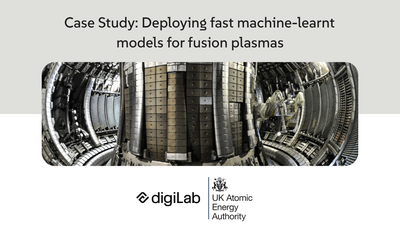
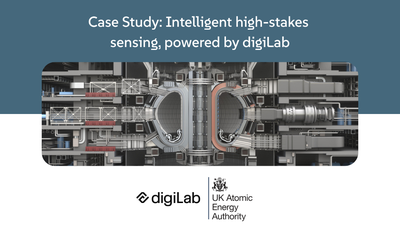
digiLab, a pioneering artificial intelligence company specialising in uncertainty quantification, has unlocked new breakthroughs in the race for clean energy through its partnership with the UK Atomic Energy Authority (UKAEA). By applying its Uncertainty Engine, digiLab has enabled the UKAEA to dramatically cut the time and cost of fusion research, paving the way for a faster, more confident path to sustainable fusion energy.
Fusion energy has long been seen as the “holy grail” of clean power, capable of delivering abundant, carbon-free energy. But the science is staggeringly complex. At the heart of the challenge is turbulence – the behaviour of plasma at over 150 million °C that bleeds energy and prevents stable reactions. Predicting turbulence reliably is essential, but traditional computational models demand millions of CPU hours and often fall short.
digiLab’s uncertainty-aware AI changes the game. By building fast, explainable models that quantify the “known unknowns” in turbulent plasma behaviour UKAEA researchers can explore reactor designs ~100,000 times faster, with the confidence of robust reliability even when data is sparse or incomplete. The result: research programmes that once took months can now be achieved in hours, with savings of over 100,000’s in CPU hours already demonstrated.
Working with UKAEA, digiLab has delivered results across turbulence simulation and intelligent sensing.
For turbulence, advanced machine learning models now predict behaviours in spherical tokamaks, one of the least understood areas in plasma physics, giving scientists powerful tools to design better-performing reactors.
For sensing, digiLab has applied probabilistic AI with genetic algorithms and Bayesian optimisation to rapidly identify the best sensor configurations for fusion devices. This prevents costly late-stage redesigns and strengthens the resilience of multi-billion-pound fusion assets.
The bigger picture is clear. In safety-critical, high-stakes industries like energy, aerospace and infrastructure, uncertainty can derail billion-pound programmes. digiLab’s approach – putting uncertainty at the centre of AI – is what makes its technology transformative. By turning “unknowns” into quantified insights, it enables leaders to move faster, reduce risk and make bolder, more confident decisions.
Dr Rob Akers, Director of Computing Programmes and Senior Fellow at UKAEA: "Delivering the fusion roadmap will require a big investment in digital technologies. And at the heart of those technologies are the solutions digiLab is working on.”
Amanda Niedfeldt, Head of Business Development, digiLab comments on the breakthroughs: “In fusion research, the cost of uncertainty is high - in compute, in time, and in design decisions.
“With digiLab’s Uncertainty Engine, we’ve helped UKAEA create fast, explainable models that don’t just make predictions, but also quantify uncertainty making data actionable, even when it's sparse.
“Some examples of the powerful impacts this unlocks are drastically faster simulations, fewer redundant runs, and smarter diagnostic decisions, which accelerates design programmes and prevents costly late-stage redesigns.”
Adam Stephen, Head of Advanced Control Unit at UKAEA: "digiLab brought a sharp focus on understanding our design challenges and finding ways to create practical and accessible tools. We had access to the senior technical staff and ideas from our discussions were rapidly converted into new features via their product team, maximising the benefits and impacts of the project effectively."
The success of this collaboration is more than a technical breakthrough. It is a proof point that uncertainty-aware AI can unlock progress where the stakes are highest. For fusion, that means bringing humanity closer to a future of limitless, clean energy. For other industries, it signals a new way to manage complexity, reduce risk and accelerate innovation.