
digiLab Developing World-First AI for Planet’s Largest Coral Reef Restoration Programme
1 Jul 2025
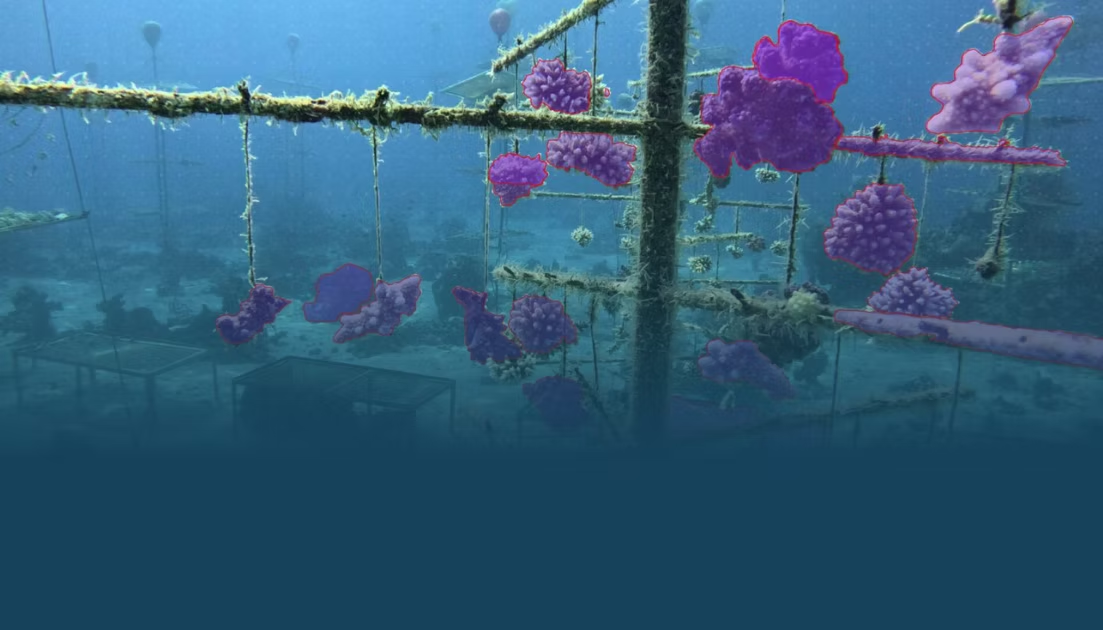
digiLab has announced a partnership with the King Abdullah University of Science and Technology (KAUST) to develop a first-of-its-kind AI-enabled digital twin platform to support the KAUST Coral Restoration Initiative (KCRI) - the world’s largest coral restoration project, in the Kingdom of Saudi Arabia.
An international collaboration between the UK and Saudi Arabia is developing a ‘first-of-its-kind’ environmental AI to predict how coral reefscapes will behave during a global restoration project
digiLab, a global leader in AI development has teamed up with Saudi Arabia’s King Abdullah University of Science and Technology (KAUST) to deliver an artificial intelligence that will be used to predict and protect the success of a 100-hectare reefscape in the Red Sea, as part of the world’s largest coral restoration project, the KAUST Coral Restoration Initiative
digiLab has announced a partnership with the King Abdullah University of Science and Technology (KAUST) to develop a first-of-its-kind AI-enabled digital twin platform to support the KAUST Coral Restoration Initiative (KCRI) - the world’s largest coral restoration project, in the Kingdom of Saudi Arabia.
This initiative, part of the KAUST Coral Restoration Initiative (KCRI), leverages digiLab’s AI expertise to enhance coral monitoring and restoration strategies across a 100-hectare reefscape in the Red Sea. By focusing on the development and integration of advanced AI solutions, digiLab is transforming traditional coral restoration methodologies.
The AI integration is led by digiLab co-founder, Dr. Anhad Sandhu, with support from Dr Liz Goergen, Head of Monitoring Visualisations and Database Management at KCRI - this two-year programme will result in using AI to fast track reef restoration and conservation, at scale, for the first time.
The AI solutions are designed to tackle critical aspects of coral resilience, such as thermal tolerance and growth. Such solutions remain critical to revolutionise how coral resilience is understood and enhanced in response to changing environmental conditions.
By deploying the AI tools, digiLab is already enhancing the capabilities of environmental sensors across the reefscape. The AI solutions not only reduce the time required for coral assessments but also increase the accuracy of data that can be retrieved from key environmental stressors like temperature and light, crucial for the propagation and survival of coral species.
The collaboration between digiLab and KAUST will set a new standard for coral restoration projects worldwide. The integration of AI in this project demonstrates a scalable model for environmental conservation efforts, offering insights and methodologies that can be adapted globally to protect and restore vital reef ecosystems in the face of continued environmental challenges.
Using advanced AI technology, scientists on the project can now closely simulate and predict the behaviour of the real-world reefscape in real-time. This capability allows for easy and accessible monitoring of the coral reef ecosystem in nurseries on land and in the sea. AI tools delve into the ecosystem to uncover crucial data, such as algae growth and signs of disease.
The KCRI project is a global demonstration of coral restoration that integrates international expertise with pioneering propagation, planting and monitoring approaches to accelerate solutions for reef ecosystems at a time of unprecedented environmental change. The project focuses on restoring and enhancing coral reefs through a large-scale coral nursery system to support coral propagation and natural reproduction, with KAUST planning to plant two million corals around the reefscape by 2030, the nurseries must be efficient. At peak capacity, the sea based nurseries will produce 100,000 corals a year, with the primary land based nursery producing 400,000.
digiLab will assist KAUST in three key areas throughout this project:
Coral Measurement - digiLab is assisting KAUST with computer vision by developing an analysis pipeline to enable more efficient video monitoring. By collaborating with KAUST's team, digiLab's AI aims to reduce monitoring time of corals from 2 months to 2 weeks, enabling faster and more comprehensive tracking.
Optimal Sensor Placement - digiLab’s innovative sensor placement system augments the data collection, using machine learning to assess optimal sensor placement. Enhancing efficiency and reducing costs by reducing the number of sensors and time needed for data collection, whilst maintaining accuracy in monitoring vital statistics, including temperature, dissolved oxygen, photosynthetic active radiation, wind and tide.
chatReef - The full digital twin is projected to reach 22 petabytes (22m gigabytes) in size, making data-driven decision-making challenging. To provide an intelligent way of searching the data within the system and maximise the value of the data, digiLab is integrating its agentic LLM platform to interact with the vast unstructured and structured data within the digital twin.
Speaking about the project, digiLab Co-founder, Anhad Sandhu, says: “digiLab's partnership with KAUST on the world's largest coral restoration project marks a significant milestone in the application of AI technology to solve the world's challenges. digiLab is supporting revolutionary methods for coral reef monitoring and restoration by developing these AI models for the reefscape’s digital twin. This collaboration not only showcases digiLab's expertise in enabling AI models in complex systems, but also demonstrates the company's commitment to addressing critical environmental challenges.”
Professor Dave Suggett, KCRI Director, says: "The KAUST Coral Restoration Initiative represents a significant step towards more effective restoration of reefs globally. By partnering with digiLab to develop an AI-enabled digital twin of the reefscape, we are pioneering innovative approaches to upscale coral management efforts, including restoration decision-making. This collaboration allows us to leverage cutting-edge AI technology to monitor, predict, and optimise our restoration strategies in real-time, potentially revolutionising how we approach coral reef conservation on a global scale. Our partnership exemplifies our commitment to catalysing positive societal and global outcomes through world-leading research and technological innovation that integrates diverse sectors."
Dr Liz Goergen, Head of Monitoring, Visualizations and Database Management at KCRI, adds: “Coral reef restoration has never been done at the scale which we are planning. Therefore, to accurately and efficiently plan, monitor and measure the progress and success of a project of this scale, we needed to look outside our typical coral reef restoration and monitoring toolbox. Partnerships such as this allow us to optimize our processes, leading to greater learnings and to the development of tools not only for our project, but for the greater restoration and coral reef communities.”
About KAUST
Established in 2009, King Abdullah University of Science and Technology (KAUST) is a graduate research university devoted to finding solutions for some of the most pressing scientific and technological challenges in the world as well as Saudi Arabia in the areas of food and health, water, energy, environment and the digital domain. KAUST is curiosity-driven, interdisciplinary.
KAUST brings together the best minds from around the world to advance research. More than 120 different nationalities live, work and study on campus. KAUST is also a catalyst for innovation, economic development and social prosperity, with research resulting in novel patents and products, enterprising startups, regional and global initiatives, and collaboration with other academic institutions, industries and Saudi agencies.