
The race to decarbonise the seas
1 Oct 2025
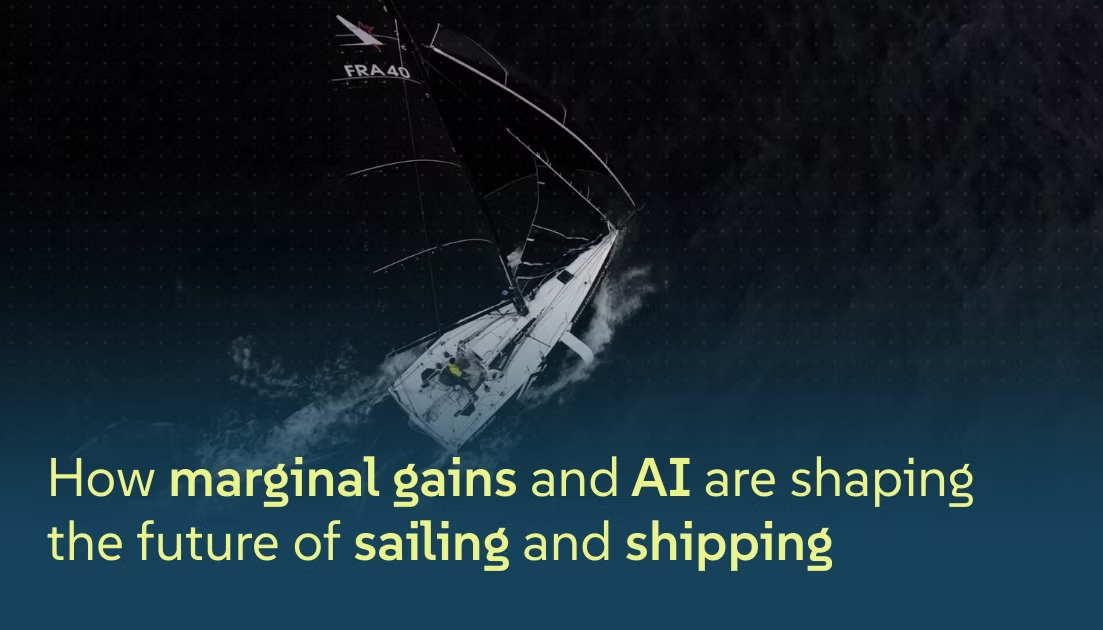
Global shipping is one of the biggest contributors to carbon emissions, and even small improvements can have a huge impact. In the UK alone, a 5% boost in shipping efficiency could save 0.6 million tonnes of CO₂ annually, that’s the equivalent of taking 300,000 petrol cars off the road.
The question is: how do we unlock these gains in a system as complex and unpredictable as the ocean?
Lessons from elite racing
Elite sailing offers a powerful testing ground.
Offshore racing shows in stark detail how marginal gains - tiny, incremental improvements - can add up to big results. A 1% improvement in sail selection here, a 1% gain in trimming technique there, and over the course of a four-day race those small edges can create a 15% performance difference. That’s often the gap between finishing mid-fleet and standing on the podium.
Recognising this, digiLab turned to racing as a living laboratory.
By partnering with Next Step Racing - the young British duo of Joss Creswell and Charlie Warhurst - they are using one of the most unpredictable environments on Earth to test how uncertainty-aware AI can help sailors prepare smarter.
Human instinct meets artificial intelligence
The 2025 Défi Paprec put this vision to the test.
Joss and Charlie relied solely on their instincts, finishing fourth overall. What the race highlighted is the potential for AI to support, rather than replace, human judgment.
Probabilistic AI is designed to map uncertainty, helping sailors spot risks and opportunities they may otherwise miss. Instead of suggesting human intuition mirrors AI, the lesson is that AI can frame decisions in a way that complements instinct, providing another lens to navigate complex, high-variance conditions and ultimately deliver better outcomes.
Offshore racing is shaped by tide, wind, and, often, fatigue. Each decision - to change sails or hold steady, to go north or south of a shipping lane - echoes hours later.
This mirrors the way AI models uncertainty: each move sets a branching path, like a game of chess at sea. digiLab’s Uncertainty Engine doesn’t prescribe a single ‘best’ route, but maps probabilities, highlighting risks and opportunities so sailors can make smarter calls.
From racecourse to shipping lanes
The lessons learned on the racecourse don’t stay there. They are laying the groundwork for commercial shipping, where even marginal gains could deliver massive economic and environmental benefits. Better route planning, improved fuel efficiency, and sharper logistics are all within reach if the same AI that supports elite sailors is applied to global fleets.
As digiLab’s CEO Tim Dodwell puts it: “Offshore racing isn’t about smooth optimisation curves, it’s discrete, high-impact choices. That’s why probabilistic AI is such a powerful lens: it helps you understand where the uncertainties lie.”
Navigating toward a greener future
From foiling yachts off the coast of France to container ships crossing the world’s busiest trade routes, this summer’s experiments are only the beginning.
By treating offshore racing as a proving ground, digiLab and Next Step Racing are helping chart a path toward a more efficient, more sustainable maritime future.
In the end, it’s not just about winning races. It’s about sharpening instincts with technology, transferring lessons from sport to industry, and ensuring that every marginal gain on the water contributes to the global race to decarbonise the seas.