
Sail and soar through storms with digiLab
4 Sep 2025
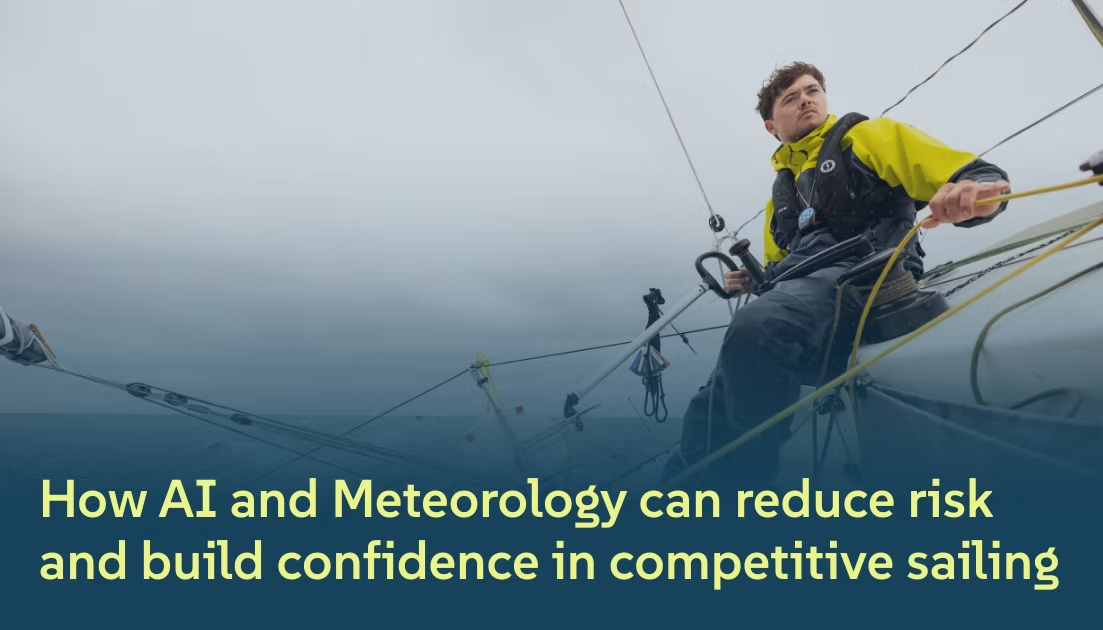
When it comes to competitive sailing, teams are at the mercy of the weather. Which means intensively planning for, modelling, and monitoring different weather scenarios before and during a race is critical for race day success. Join Meteorologist Ella Boxall, as she breaks down how Uncertainty Quantification in digiLab’s AI platform can help her to interpret and apply offshore weather data to improve the team’s tactical decision making on the water.
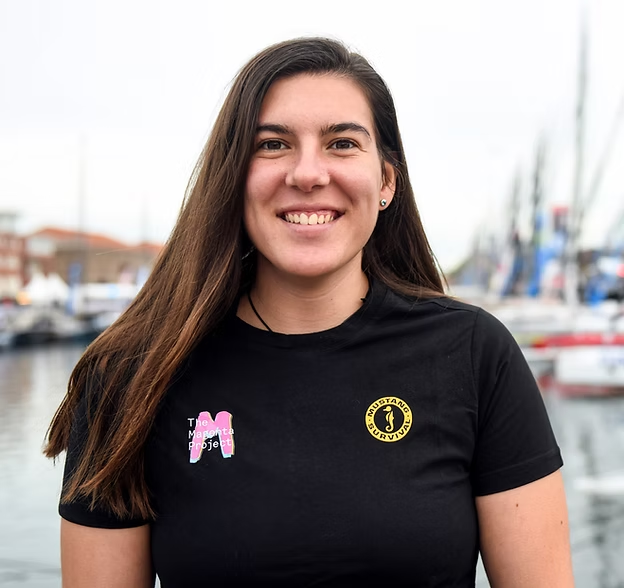
Hi Ella! With Joss and Charlie hitting the waves soon for the ‘Le Défi Paprec’ race, can you tell us a bit about your role on the digiSail team?
I am the Team Meteorologist and Data Analyst, helping Joss and Charlie with both the lead up weather forecasting, routing, and strategy, as well as post race performance focused debriefs.
I’ve been navigating in various different offshore campaigns for the last few years and I have a Masters in Applied Meteorology from the University of Reading where I did my project on the North Atlantic Speed Record set in 2009 by the Ultim Banque Populaire — exploring whether cyclone clustering and other variables would be favourable for breaking the record.
How do you use meteorological data when planning for races?
In the build up to a race, I’ll go through all the meteorological data to build a clear picture of the weather scenario — looking at different models, observations, and trends to see what’s driving the system.
From there, I put together a playbook outlining the key decisions the team is likely to face, the different options on the table, and the factors that could influence those calls. This means we can go in with a shared plan and an idea of what the big moments will be, rather than trying to figure it out on the fly. Once that’s set, I hand it over to the boys to take into their race. My role then shifts more into monitoring how reality lines up with the forecast.
You’re dealing with offshore data, rather than land-based. Does this change your approach to forecasting?
On land you’ve got weather stations, radar, and plenty of local data to feed into forecasts. But offshore is a different story; the models have far fewer observations to work from and generally run at lower resolution over the ocean. The marine environment itself also adds complexity: rapidly changing wind patterns, the interaction between waves and currents, and the sheer scale of oceanic systems mean that small forecast errors can lead to major strategic consequences.
For offshore racing, this makes forecasting not only about predicting the weather but also about interpreting uncertainty, spotting model weaknesses, and translating forecasts into tactical decisions on the water.
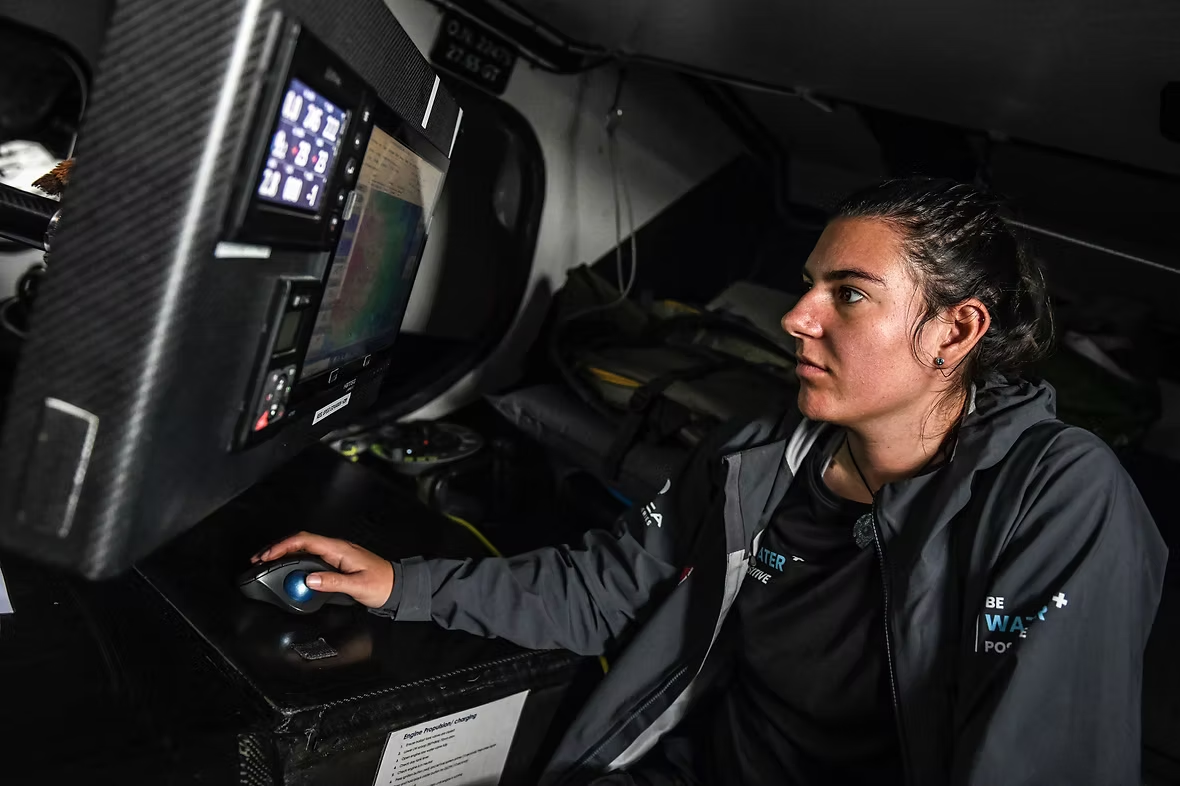
How does Uncertainty Quantification help make sense of this kind of noisy or conflicting data?
When you’re dealing with weather data, especially offshore, it’s rarely neat and tidy. Different models might disagree and observations can be patchy. Uncertainty quantification helps make sense of that by putting numbers on how confident we should be in a particular scenario.
Instead of treating one forecast as ‘right’ and another as ‘wrong’, it highlights the range of possible outcomes and the likelihood of each. That way, if two models are pointing in different directions, you can weigh the risks, understand the spread, and plan around both the most likely case and the worst case. For racing that’s invaluable — you can make decisions with a clearer view of the risk attached.
How does digiLab’s AI complement or enhance traditional weather modelling?
Traditional weather models are powerful, but they all have their downsides, whether that’s resolution offshore, local effects, or the way small errors can build up over time.
What digiLab’s AI does is help bridge that gap. It pulls in huge amounts of observational data and learns where the models typically go wrong, while also quantifying the uncertainty and risk around different scenarios. That means we don’t just know which forecast is most likely, but also how confident we can be in it — a huge advantage when making high-stakes decisions offshore.
It sounds like confidence really is key when it comes to racing, and AI can help you build that. How do you see Meteorology and AI working together in the future of offshore racing?
I think the future is in using AI to make the forecasts more accessible. Offshore, we’re often working with conflicting inputs from different models, and AI can help fill the gaps — showing where models are likely to be wrong, pulling out patterns, and putting numbers on the uncertainty. It also means we can make better use of historical reanalysis, spotting long-term trends that give us an edge when preparing for future races.
For me it’s about faster, sharper insights that, when combined with experience, lead to better decisions on the water.
Final question — beyond sailing, where do you think this approach to combining weather data and AI could make a difference?
There’s a huge amount of potential beyond sailing. Shipping is an obvious one — better forecasts and clearer risk quantification can save fuel, cut costs, and make it more efficient. Renewable energy is another area where small improvements make a big difference: predicting wind and solar output more accurately, or understanding long-term weather patterns for site planning.
And even sectors like agriculture or disaster response could benefit from combining AI with traditional modelling in order to handle conflicting data and quantify uncertainty.
This approach can help people act with more confidence, wherever weather plays a key role in decision making.